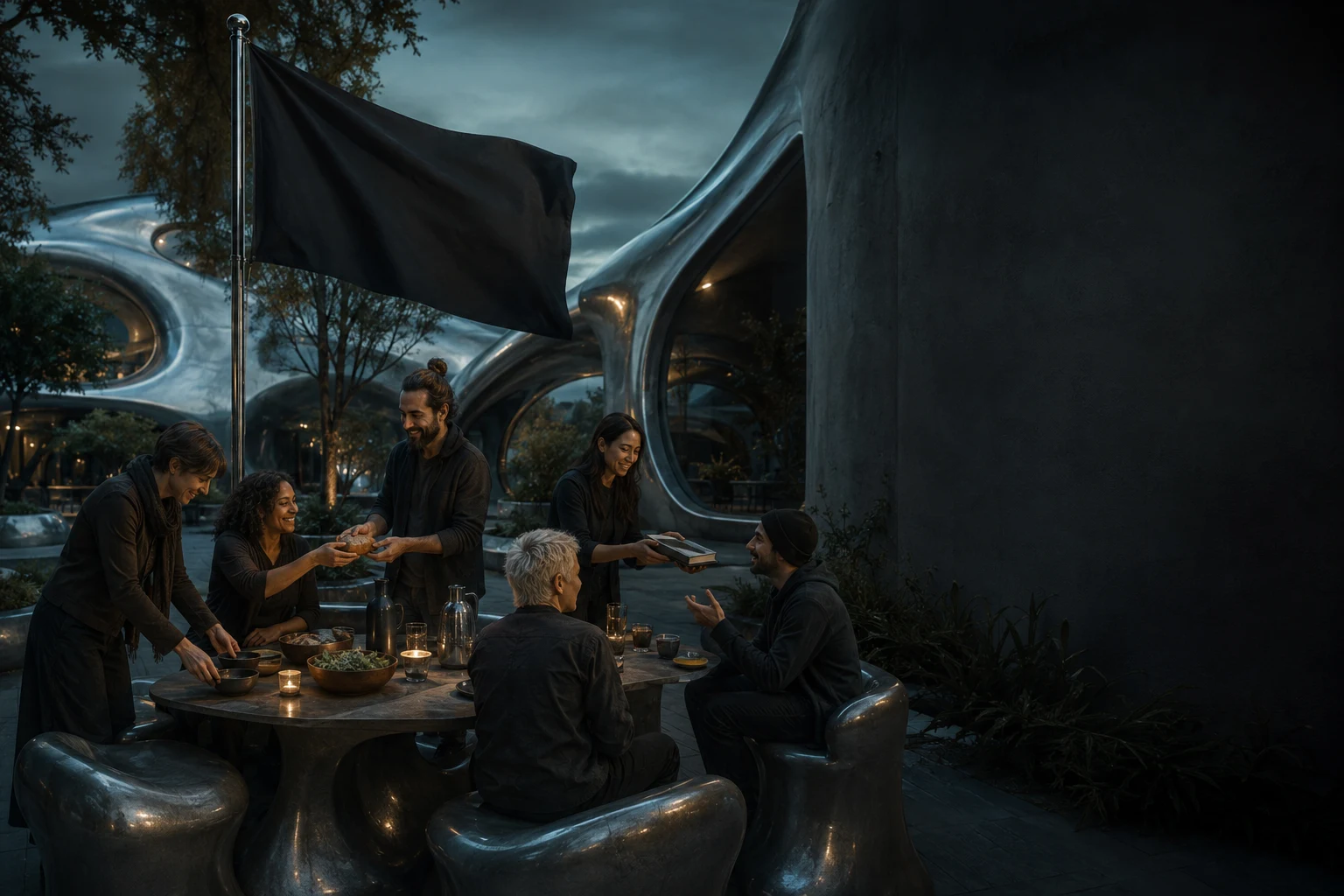
I am an anarcho-capitalist. The starting point for me is that people should be free to direct their own lives, own what they legitimately acquire, and cooperate on terms they choose. I want a society where the state has no special claim over our bodies, our work, or the relationships we build.
I did not arrive here through an economics textbook. I first heard the word "anarchy" through the Sex Pistols. It arrived as noise, attitude, and a refusal to assume that the people in charge deserved to be there. The philosophy came later.
Years afterward, walking into the Wooden Shoe Bookstore in Philadelphia gave that word a different weight. Here were people keeping a space alive through voluntary work and shared commitment. I could respect the cooperation I saw there without adopting every political argument on the shelves. That experience remains part of my story, even as my own position has become more clearly rooted in property rights and markets.
For me, the connection is consent. People can choose to run a collective, start a business, work independently, or pool resources with friends. A free society should leave room for all of those arrangements.
My life belongs to me
Self-ownership is where I begin. My body, time, and labor are mine to direct. Other people have that same claim over their own lives. Neither a majority vote nor an official title should give someone permission to initiate force against a peaceful person.
That is how I understand the non-aggression principle: a standard against initiating force, backed by respect for people and their property. It leaves room for defending yourself and seeking restitution when someone causes harm. It also makes fraud and theft incompatible with voluntary exchange. An agreement obtained through deception is not meaningful consent.
Murray Rothbard’s For a New Liberty develops the rights-based case for a society organized around individual liberty and private property. It is one starting point for understanding the anarcho-capitalist argument I am describing here.
Property makes independence possible
Property matters because independence requires something more concrete than permission. A home, a workshop, savings, a piece of software, or the tools used to make music can give a person room to act on their own judgment.
I believe people should be able to acquire property peacefully, exchange it, give it away, and decide how it is used. Legitimate ownership matters: calling something property does not erase theft or coercion in how it was obtained.
Shared ownership belongs in that picture too. Friends can buy land together. Workers can form a cooperative. A community can support a library through donations. The question is whether the people involved have chosen the arrangement and respected the rights of others.
Markets need the freedom to refuse
What draws me to markets is the possibility of people coordinating without having to agree on one plan for everyone. You make something. Someone else decides whether it is useful enough to buy. People experiment, negotiate, compete, and change their minds.
My support for capitalism is tied to that freedom of exchange. It does not give a business a pass when it seeks subsidies, political protection, or rules that prevent competitors from entering. I judge those privileges by the same standard I apply to the state: who is being compelled to support whom?
A company should have to earn participation. Being privately owned does not put it beyond criticism, and a contract does not make every difficult question disappear. Exit costs, unequal bargaining power, and the ability to seek redress matter. I want more credible alternatives and fewer barriers to building them.
Cooperation by choice
Voluntary generosity fits naturally into this outlook. People can support one another because they care, because they share a goal, or because they have made a reciprocal commitment. Profit, charity, and mutual support can coexist.
CrowdHealth is a personal example of why this interests me. I am both a member and an employee, so I have a direct connection to the company. Its approach to voluntary healthcare crowdfunding resonates with my preference for people choosing how they support one another.
I see that as one practical expression of a value, rather than proof of an entire political philosophy. A business operating within today’s institutions cannot demonstrate what a fully stateless society would look like. What matters to me is the opportunity to participate in something whose emphasis on choice aligns with my own.
The same interest runs through my creative and technical life: keeping a personal website, making music independently, and exploring ways for people to support creators directly. Ownership gives me responsibility for what I build. Voluntary support gives other people a choice about joining me.
The questions worth taking seriously
A serious anarcho-capitalist position has to engage with disputes, violence, pollution, and the risk that private protection agencies could become coercive powers themselves. It has to explain how people with few resources could obtain protection and fair treatment. Saying "the market will solve it" is not enough of an answer for me.
David Friedman’s The Machinery of Freedom explores how competing institutions might provide law and enforcement without a state. That is a useful argument to examine alongside the ethical case: what incentives would these institutions face, and how could people hold them accountable?
There are disagreements within anarcho-capitalist thought, and larger disagreements with other anarchist traditions about property, wage labor, and economic power. I want this page to make my own position clear while leaving room to examine those arguments honestly.
My direction is toward self-ownership, private property, free exchange, and cooperation by consent. The practical question I keep returning to is what I can build, support, or participate in that gives people more control over their own lives.